Blockchains
Our tokenization solution is developed to run on the below blockchains:
| Blockchain | Nexus internal code |
|---|---|
| Algorand | ALGO |
| Stellar | XLM |
| Ethereum | ETH |
| Polygon | POL |
| Ripple | XRP |
| Xahau | XAH |
Mainnet vs Testnet
Two terms you will frequently encounter are mainnet and testnet:
- Testnet: A testing environment that simulates a blockchain network. It is used for development and validation without real financial impact.
- Mainnet: The live, fully operational blockchain network where real transactions occur and assets have actual value.
For your Nexus environments:
- In the test environment, you may choose to connect to either testnet (recommended for development and testing) or mainnet, depending on your use case.
- In the production environment, you should connect to the mainnet of your selected blockchain(s), as this is required for real transactions.
Ecosystems
Nexus supports two types of ecosystems:
- Closed loop ecosystem: The token can only be held by whitelisted consumers, service providers and devices through strict access control, reducing regulatory burden for service providers. This is accomplished by enabling the Authorization Required token setting when creating the token.
- Open ecosystem: The token can be held by any account on the blockchain. For stablecoins, the token is offered as a digital alternative to traditional money that is more efficient, secure, and accessible. Possible applications range from cross-border payments to trading liquidity and decentralized finance (DeFi) solutions.
Which Blockchain should you use
We generally recommend the Algorand blockchain, particularly for closed ecosystems. However, the choice of blockchain is yours, and multiple blockchains can be used simultaneously. Below are some important considerations:
| Algorand | Stellar | Ethereum | Polygon | |
|---|---|---|---|---|
| Minting | Fixed | Unlimited | Unlimited | Unlimited |
| Grouped payments | 16 | 100 | 1 | 1 |
| Consensus protocol | Proof-of-Stake (PoS) | Stellar Consensus Protocol (SCP) | Proof-of-Stake (PoS) | Proof-of-Stake (PoS) |
| Cost-efficient | Fixed trx cost 0.001 ALGO | Min trx fee 0.00001 XLM | Depends on network congestion | Depends on network congestion |
| Settlement time | ~3.3 seconds | ~5 seconds | ~3 minutes | ~3 minutes |
| Fee account creation | Yes | Yes | No | No |
For unlimited token minting, use Stellar, Ethereum, or Polygon. Algorand requires a fixed supply defined at the time of creation, which cannot be modified later.
To group more than 15 payments atomically, use Stellar, which supports up to 100 operations per transaction. Algorand has a limit of 16 (one used for fees), while Ethereum and Polygon support only single payments.
Algorand, Ethereum, and Polygon use Proof-of-Stake (PoS) consensus, offering significantly greater energy efficiency than Proof-of-Work systems like Bitcoin. Stellar uses the Stellar Consensus Protocol (SCP), which is also energy-efficient. Among all blockchains supported in Nexus, Algorand is generally regarded as the most energy-efficient.
Algorand and Stellar are both cost-effective for transactions and account creation fees. Algorand charges a fixed fee of 0.001 ALGO per transaction and account creation, offering predictable costs, even during network congestion. Stellar's fees start at 0.000001 XLM per operation, plus the number of operations times the base fee of 0.000001 XLM. Stellar requires 1 XLM minimum balance for account creation. Both Algorand and Stellar are significantly more cost-efficient than Ethereum and Polygon, which can incur higher fees, especially under network load.
Algorand offers the fastest settlement, with a settlement time of about 3.3 seconds compared to Stellar's average of 5 seconds. While both provide near-instant finality, Ethereum and Polygon transactions usually takes around 3 minutes to be fully settled.
This guidance is primarily based on Nexus-specific requirements and technical features, not broader factors like user base or market adoption.
NOTE
The implementations of the various blockchains within Nexus sometimes differ in features provided. This is either due to the blockchain unable to support such functionality or a deliberate choice for the Nexus system to not support it (for now).
For example, there is no support for MANAGED accounts for Ethereum and Polygon, this limits customer-to-customer payments executed through Nexus and other features that require the use of managed accounts.
In general the Algorand and Stellar implementation have the most complete feature set available
Fee payers
- The token operations you will carry out on behalf of your customers imply the payment of a fee on a blockchain to confirm the operation. The crypto of this blockchain, also called the native asset of the blockchain, is needed to pay the transaction fees.
- Certain blockchains (e.g., Algorand and Stellar) support fee account creation. These dedicated Fee accounts are setup by us when setting up your environment to automatically pay these fees with each operation to remove complexity.
- For blockchains with no fee account support (e.g., Ethereum and Polygon), Nexus pays transaction fees from the Issuer account instead of a Fee account.
- Fee-paying accounts must always maintain a sufficient balance of the blockchain’s native asset (e.g., ALGO for Algorand, XLM for Stellar) to cover transaction fees.
Fee account monitoring and alerts
- Fee accounts are visible in the Nexus portal under the Fee Payers section, along with their status and current crypto balances.
- Nexus continuously monitors fee account balances to ensure uninterrupted operations.
- Automated alerts are sent to configured email addresses when fee account balances are low or depleted, helping to prevent service interruptions.
Minimum fee account balance
- Each blockchain has a defined minimum balance requirement for the designated fee accounts to ensure that transaction fees can be covered.
- Setting the minimum fee account balance defines when fee accounts are marked as Empty/Low Balance. When the fee account is marked as Empty Balance they are no longer usable as fee accounts until the balance is replenished above the defined minimum.
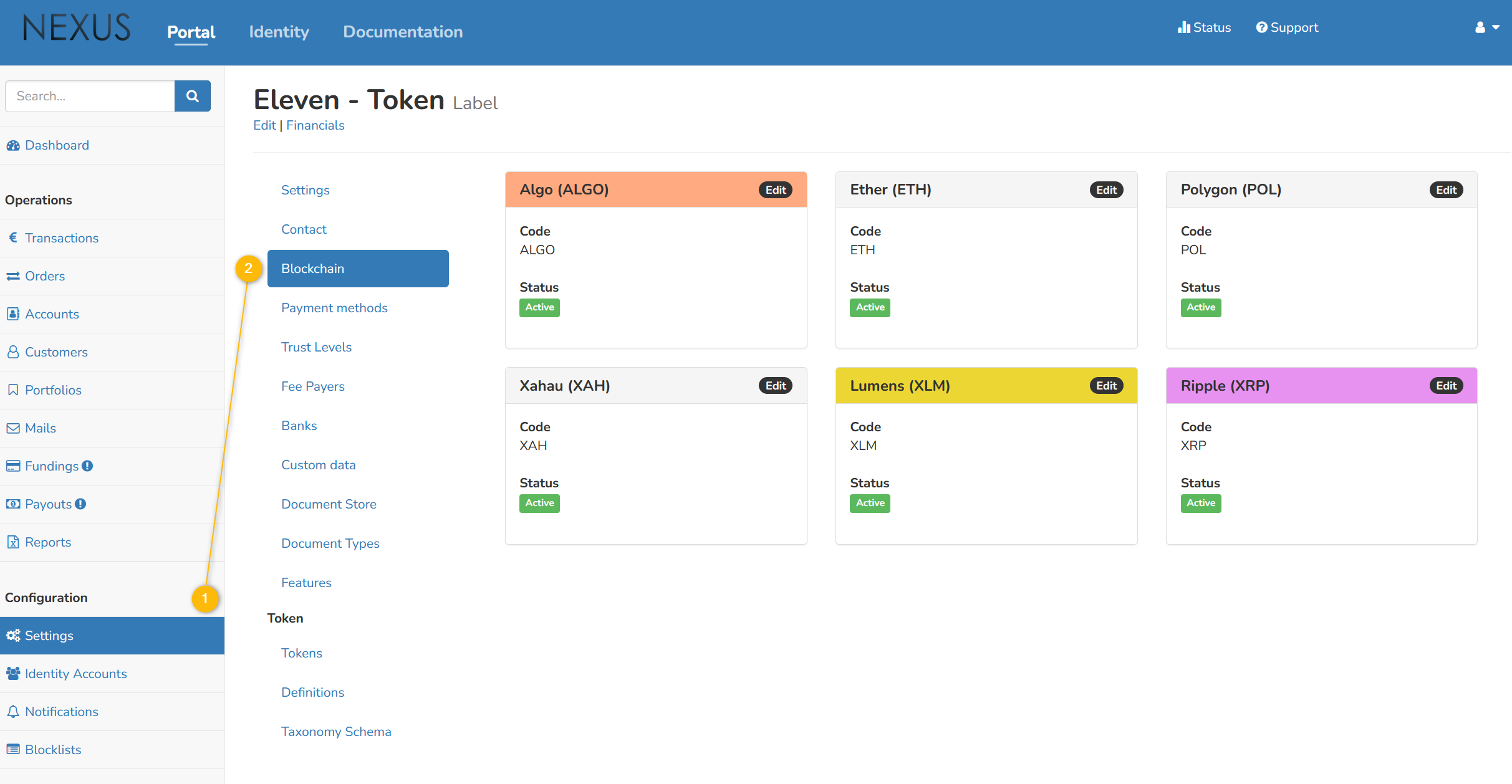
- To adjust the minimum balance:
- Navigate to Setting and select Blockchain in the Nexus portal.
- Select a blockchain to edit
- Update the Minimum fee account balance field with the desired amount.
Types of blockchain
Two main types of blockchain are currently available on the market, namely public and private ones.
Nexus allows to be connected with public blockchains, where the main crypto-currencies are exchanged (e.g. Bitcoin, Ethereum and others). These are distributed and decentralized, meaning that no single entity has control over it but the truth of the operations happening on it are in function of the agreement of the nodes in the network. These blockchains are often called permissionless, because there is no need to know the real identity of an user to execute transactions.
Private blockchains (often called permissioned) are fundamentally different from the public ones, because they rely on the verification of the identity of an user in order to assign specific grants and permissions on a platform. These blockchains are usually designed and used internally by a private company, for instance to manage the movement of value internally. Nexus is not built to support private blockchains, but Quasar (another Quantoz product) is specifically designed for this use case.